
Notifications
COFFEE WITH MICHELA COLORITO: WHY EVERY GOOD DESIGN STARTS WITH A NEED
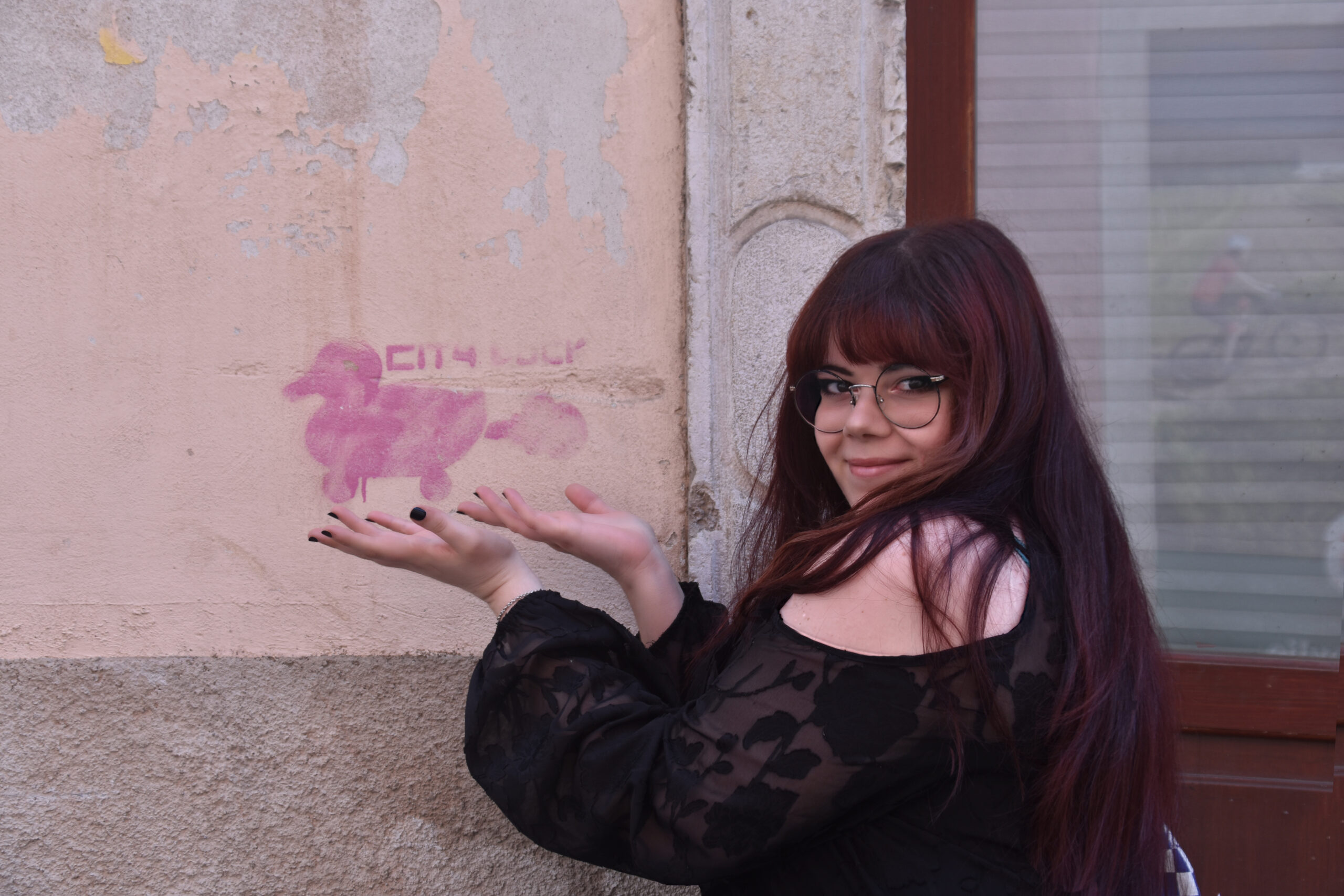
Michela is one of those people you first notice by her quietness. And then by how full that quietness actually is. She talks softly, chooses her words carefully, but in her head there’s clearly a whole constellation of connections happening at once. While you’re still trying to find the right sentence, she has already mapped out the concept, the metaphor, and the user journey.
During her months at PiNA as a European Solidarity Corps (ESC) volunteer, she is already leaving a clear trace of playful, smart visual concepts that help people pause, smile, and think.
We’re in the library, on one of those cold, sunny Koper days when the burja is shaking the windows, but the light is soft and kind. I joke about needing to “set the scene” for the interview; she smiles and says she’s feeling good. We start at the beginning.
“I didn’t want to go just anywhere”
I ask Michela how she ended up here. “Before coming to Slovenia, I was doing civil service in Italy, in Termoli,” she tells me. “They were looking for someone to work on visual communication in the touristic area of the city, so I applied and got in.” During that time she met a person who saw something in her work and also in her limits. “I’ve always been very introverted,” she says. “And when I took risks, they were controlled risks. He suggested I look into the European Solidarity Corps as a way to challenge myself more. Going to another country, another language, another context.” She admits she didn’t jump immediately. No romantic “I knew right away”. Instead, she let the idea marinate for a year.
“Then, in January, I started applying through the ESC portal. One project in Spain, in Lorca, and one at PiNA in Koper. I knew I didn’t want to go ‘anywhere’, I wanted a place that spoke to me. When I found PiNA and HEKA, this mix of art, science and technology, something clicked. Koper, with the sea, reminded me of familiar places but with a new twist. It felt right. I got selected in Spain first. Then I messaged PiNA and they wrote back: ‘You’re in.’ I wrote back to Spain to say I wouldn’t be coming.”
First days by the sea
I asked her what those first weeks in Koper felt like. “For me, the sea is essential,” she says immediately. “It’s a kind of emotional anchor. When I have a bad day, I go for a walk by the water and things feel lighter. So arriving in a city with the sea right there was already a big comfort. Of course, at the beginning everything was confusing with the language,” she continues. “When to speak Italian, when to speak English, how things work. And there were the usual flatmate challenges. But step by step, with time, routines, and familiar faces in shops and at work, it became home.”
She pauses and adds: “What helped most was how PiNA welcomed me. My coordinator, my mentor and colleagues … I always felt I had someone to talk to when things were difficult. The atmosphere is very organic. You can be honest, ask for help, and also offer help. That makes a huge difference when you’re starting a new life in another country.” Listening to her, it just confirms to me how much these small, everyday gestures matter. A coffee, a joke at the office, someone asking “How are you really?”, they become infrastructure.
How design lives in her everyday
We moved to her design process. I admit to her that from my perspective it often looks like magic. I throw a complex concept on the table, and she returns with something visually sharp and emotionally spot-on. “The truth?” she says. “The design part doesn’t start when I turn on the computer. It starts when I wake up and it continues until I fall asleep. The brain keeps connecting things, even when I’m cooking or playing video games. The real work is sometimes to stop.”
“Practically, when I arrive at PiNA, I turn on the computer, say hi to colleagues, drink coffee, and then I open my ‘tables’,” she explains. “I have a task table with deadlines, and a daily log where I write what I worked on, what was difficult, what I achieved.” This daily log, she reminds me, was something her coordinator suggested at the beginning. “It became a tool against impostor syndrome,” she says. “Designers often forget what they actually do during the day. You finish something and immediately move to the next task. When you write things down, you can look back and see: ‘Okay, I did all this. It wasn’t “nothing”. Then I prioritize tasks, talk to project managers when something is unclear, and try to keep communication open,” she adds. “There’s the visible part, files, layouts, emails, and the invisible part, where ideas keep moving in the background.”
“I need a need”
I ask her: Where does a project start for you? “For me, everything starts with a need,” she says without hesitation. “I always say: I need a need. If there is no real need, then the design is just decoration.” In a world full of “content”, the idea that design must answer a need feels almost radical. “So first I try to understand the need,” she continues. “I read the brief carefully or sit with the project manager and listen: Who are we talking to? What is the goal? What problem are we trying to solve? Then I research. A lot. I look at the target group, their interests, the platforms they use, the kind of visuals and humor they respond to. I look at trends, but also at books, films, mythology, everyday objects. Anything can become a visual metaphor later.”
Only after that she comes to the part most people imagine as “the work”. The sketching. “I don’t go straight to the computer,” she says. “I make small layouts, draw ideas, play with possible compositions. Visual communication is still communication. If the visuals just repeat the text, it’s empty. The goal is to add something, a feeling, a joke, a thought. Something that makes people stop for a second.”
The stories behind her concepts
I tell her I want more people to know about the concepts she developed here, to understand the thinking behind them. So we talk about Where is PLAC-o?, the tear-off questions, and choose your aesthetic.
“They all came from thinking very seriously about the people we wanted to reach,” she says. “With Where is PLAC-o? I was thinking about students and the classic Where’s Waldo? game. We wanted people to stop in front of the poster and stay there for a minute, not just pass by.” So we went big, a large format you can see from far away. “When you come closer, you realize it’s a game. You look for the character, you laugh a bit, you feel good and only then you read more about PLAC. In that time, you have already created a positive connection with the project.”
“The tear-off questions came from those A4 flyers you see everywhere,” she continues. “‘Need a haircut?’, ‘Lost cat?’, with phone numbers you can tear off. I thought: people often don’t know what to ask at events. What if we give them ready-made questions they can take with them?” So you tear off a question, maybe put it in your phone case, and you already arrive at PLAC with something in your pocket, a starting point. “It’s a tiny tool, but it reduces anxiety and invites conversation,” she says.
With choosing your aesthetic for the sewing workshops, the process began with actual data. “We looked at who actually applied: mostly young women of a certain age group. At that time, ‘find your aesthetic’ was a strong trend on social media. It felt natural to use that language. We kept the visual identity of the project on the outside, and inside we played more: collage, textures, a ‘pick your style’ feeling. It was both strategy and play. Not ‘let’s be trendy’, but ‘let’s use a trend in a meaningful way’.”
Reaching people in a noisy world
I can’t resist asking the big question: Do you feel it’s harder today to reach people than it was before? “Communication has changed a lot in the last ten years,” she says. “Social media, the pandemic, constant online presence… Attention spans are shorter, yes. But I don’t think about ‘people’ as one big mass. I think in niches. Small communities that sometimes overlap.” You can still reach people, she insists, but you have to be precise. “You need to know where they are and how they live,” she says. “What platforms they use, what spaces they move in, what visuals they trust. If you don’t have time or tools to research this, then yes, it feels very hard. If you do, it can actually become easier, because you are not trying to speak to everyone anymore. You are speaking to someone specific.”
Visual pollution and responsibility
We touch on the concept of visual pollution. “I think of it like a sound,” she says. “No musician wants to intentionally create noise pollution. They want to make something that carries meaning. With visuals, we often accept that the world is full of random, loud, poorly thought-out images. It’s tiring.” So she asks herself: Does this thing really need to exist? “Does it answer a need? Does it help someone understand, decide, or feel something important? Or does it just add to the noise because we felt obliged to publish ‘something’?” She’s very clear about the limits too. “Designers can’t fix the world,” she says. “But we can take care of our small communities. We can reduce visual noise, create clarity, and show that visuals can be gentle, smart, and respectful. We know how color and form affect perception. There’s science behind it. So I feel we have some responsibility to use that knowledge with care.”
The most challenging project
When I ask her which project pushed her the furthest this year, her answer comes quickly. “My personal project with Dobra pot, for sure,” she says. They’re working on a short 2D animation connected to memory and heritage, themes that are close to her heart. “Animation is different from graphic design because everything moves and unfolds over time,” she explains. “You have to think about rhythm, transitions, sound. It’s also challenging because I have a lot of freedom. That sounds nice, but as a creative person, a blank page with no rules is scary. You have to invent your own rules: a visual language, a structure, boundaries.”
Then there is the very real, non-romantic part: “Many drawings, many decisions, limited time,” she says with a small smile. “You have to constantly ask: what is the simplest way to tell this part of the story without losing the depth? It’s demanding, but it’s also the project where I felt most like a ‘complete’ designer from concept to script to visuals and now animation.”
“This is just how my brain works”
As we start to wrap up, I ask what these months at PiNA taught her about herself as a designer. “That this is simply how my brain works,” she says. “And that it’s okay.” For years, she tried to separate her life into boxes: now I work, now I rest, now I do something non-creative. “Here, with a safe environment at PiNA and at home, I realized that my brain connects things all the time,” she says. “Even when I play video games with my boyfriend, I reorganize systems and interfaces. He laughs and asks me to stop ‘designing’ in the game. But that’s just how I function.” Instead of fighting it, she started to accept it and work with it.
“By listening to people’s needs and trying to make things a little better through design, even if it’s just for one person,” she says. “I feel closer to what people call their ikigai.”
Would she recommend ESC?
My last question is the classic one, but I still want her answer on record: Would you recommend the European Solidarity Corps to other young creatives? “Yes,” she says. “Absolutely. Because it gives you a structured chance to live in another country, meet new people, and work in a field you care about. I feel more confident in my skills now. I feel safer in my own skin. And now I know that places like this exist, places that match your values and interests.”
She adds a practical note: “My advice would be: do your research. Look closely at the organization, their projects, their vibe. You’re going to spend months of your life there. If there is alignment, the experience can change you in very good and unexpected ways.”
The burja is still blowing outside when we finish, but in the library the light is warm and soft. I stop the recorder and think to myself that if design is, as she says, about answering needs and making things a little better, then we were very lucky that her “need” led her exactly here.